



Hidden History: Old Wye Mill and the Breadbasket of the Revolution

In the early 18th century, agriculture boomed in the Middle Colonies—New York, Pennsylvania, New Jersey, and Delaware—and the region emerged as a chief food producer and exporter. In fact, the amount of wheat harvested led to the area becoming known as “the breadbasket.” Millers ground wheat into flour used for making bread, biscuits, pastries . . . and firecakes.
Firecakes were not a particularly favored menu item for Revolutionary War soldiers, but instead a tasteless staple that warded off starvation. Created by mixing flour and water, and perhaps salt if it was available, the mixture was formed into small flat biscuits and cooked on an open fire. Once the “bread” hardened, it kept for weeks. Firecakes were similar to the hardtack consumed by Civil War soldiers nearly a century later.
By the time the Revolution ignited in 1775, Maryland’s Eastern Shore had already begun to shift away from its heavy dependence on soil-depleting tobacco crops while ramping up grain production. Shortly thereafter, in the early days of war, three of the primary breadbasket colonies—New York, New Jersey, and Pennsylvania—suffered major British attacks (including foraging raids), causing great harm to crops.
While the Eastern Shore experienced substantial and sometimes violent loyalist-patriot divisions, no major conflicts were fought in Maryland; therefore, farmland was not reduced to battlefields, and major raids did not destroy wheatfields. Maryland, and the Eastern Shore in particular, was ripe for feeding the Revolution.
Mildred C. Schoch, in The Endeavours and Exertions of Queen Anne’s County, Maryland During the Revolutionary War, spoke to this: “The State of Maryland made great contributions to the vast supply of provisions that were needed to carry on the military operations of the American services. The Eastern Shore carried the main burden of this demand, particularly the upper counties. No other section of Maryland was called on for these provisions to such an extent and one could certainly say that the Upper Shore was the bread basket of the armed forces.”
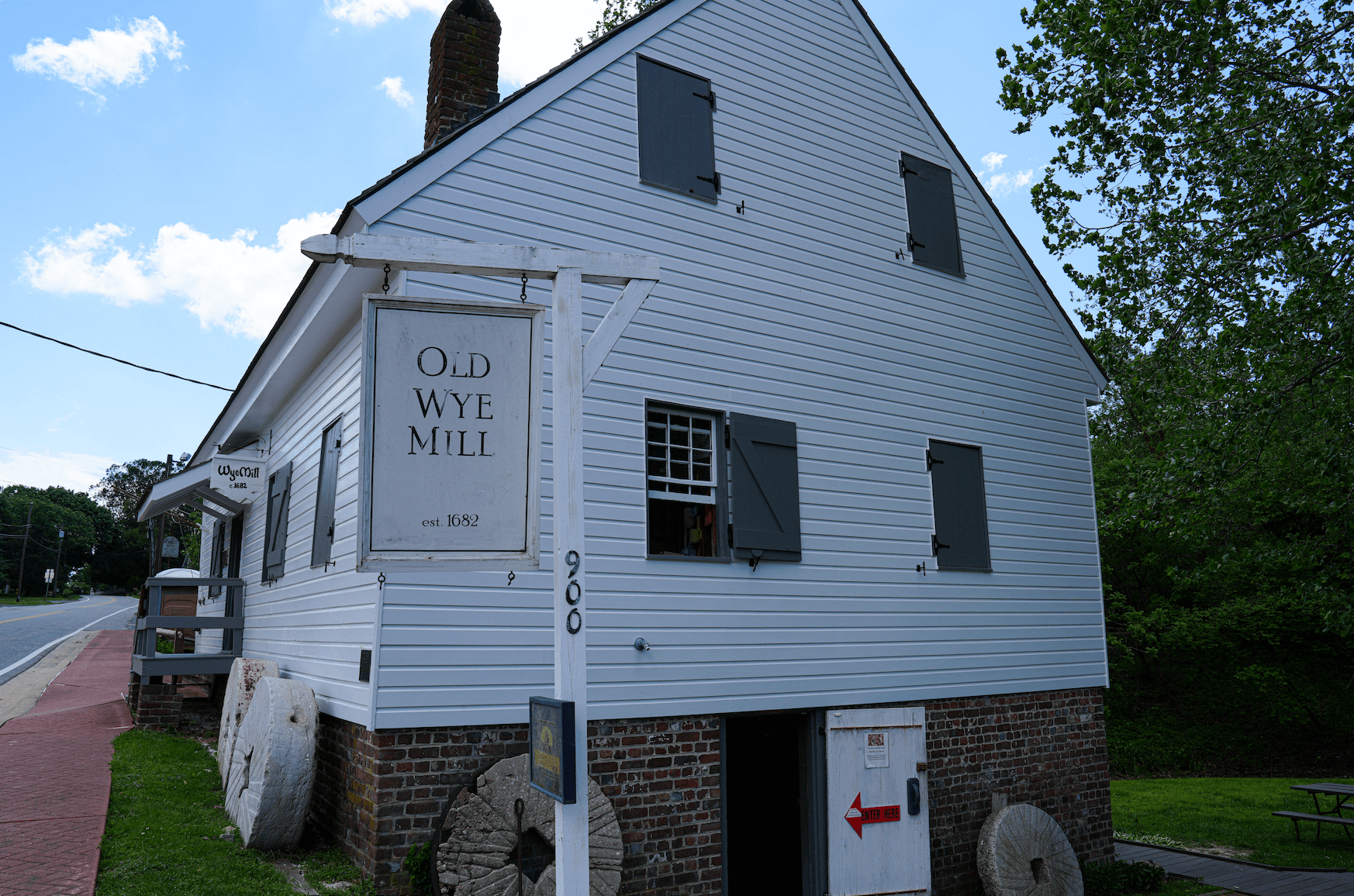
Old Wye Mill was one mill important to putting the Eastern Shore on the map as a center of the Breadbasket of the Revolution. It was among many mills scattered throughout Queen Anne’s County and beyond, operations bordering streams and rivers that produced everyday needs such as flour, livestock feed, cloth, lumber, and gunpowder. A Maryland Historical Trust survey reports that the town of Wye Mills was so named because of three mills operating along the Wye River. Of the three, only Old Wye Mill remains. Now the oldest continuously operated water-powered grist (grain) mill in the United States, Old Wye Mill still grinds wheat on or near the site where the original structure was built in 1682. According to a 2021 study of structural timbers, the current building was likely reconstructed in 1753.
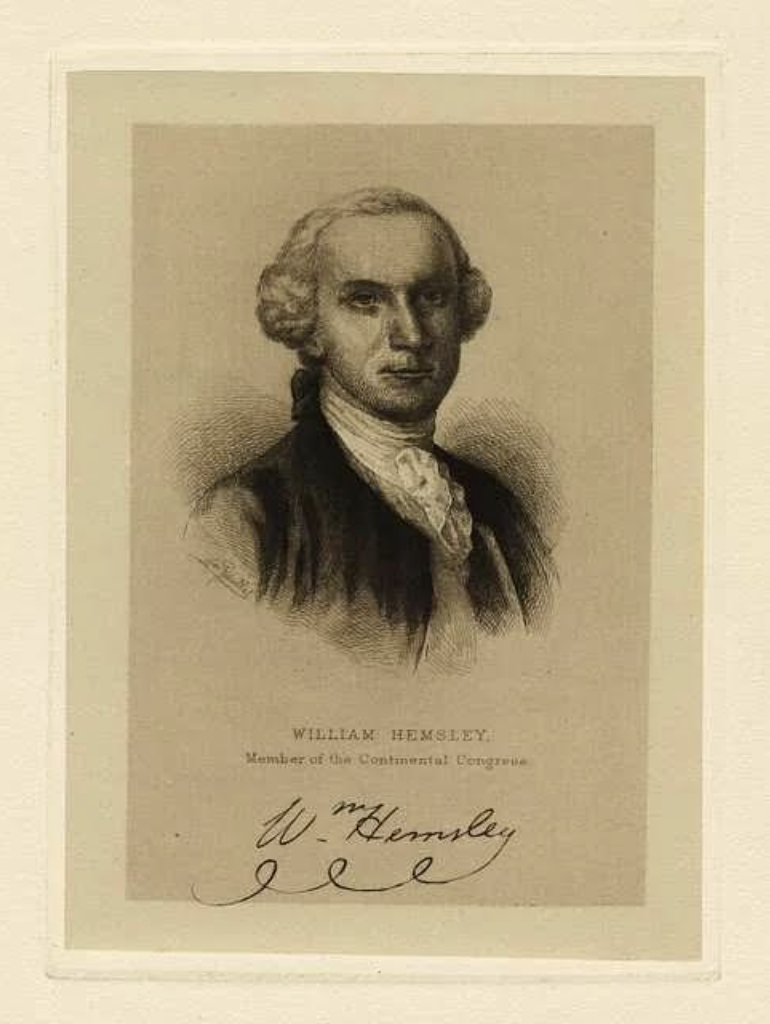
At the heart of this endeavor was Colonel William Hemsley, a wealthy planter and third-generation owner of Cloverfields, a Queenstown estate dating to 1705. Hemsley served as Colonel of the Twentieth Battalion of the Queen Anne’s County Militia, although his more heroic war efforts are related to his activities as procurement officer responsible for securing grain, flour, corn, and other products and supplies for General Washington’s often-desperate troops. Hemsley’s purchase and repair of the mill was timely: The business had passed through a number of hands before he acquired it from Edward Lloyd, IV in 1778 in the midst of the army’s extreme supply shortages and great suffering of troops. Listed with Old Wye Mill at the time was a fulling (cloth) mill, mill houses, and a bake house.
An example of Hemsley’s procurement efforts includes Congress issuing him 10,000 pounds in 1779 “for the purchase of wheat, flour and bread.” The wheat was ground and, with other products, transported to Colonel Hollingsworth at the Head of Elk (Elkton) warehouses for distribution. The following year, Hemsley shipped out an additional 400 barrels (or 78,400 pounds) of flour from Emerson’s Landing (Wye Landing), the site of Emerson’s warehouse. Depending on water levels, quartermasters, soldiers, or paid civilians transported products by oxcart to other county waterways. In addition to flour, wheat, and bread, the Eastern Shore provided cattle, hogs, lambs, salt, and supplies such as horses, clothing, arms, and gunpowder to the military. Spirits were also requested and supplied, particularly whiskey (used medicinally and otherwise).
Along with procuring products from other plantations and mills, Hemsley and the Old Wye Mill miller, Joshua Kennard, continued to supply the army with large quantities of flour until the end of the war. In a letter dated October 12, 1781 (one week before the British surrender at Yorktown) General George Washington wrote to Maryland Governor Thomas Sim Lee, “Give me leave to return you my sincerest thanks for your exertion on the present occasion – the supplies granted by the state are so liberal that they remove every apprehension of want.”
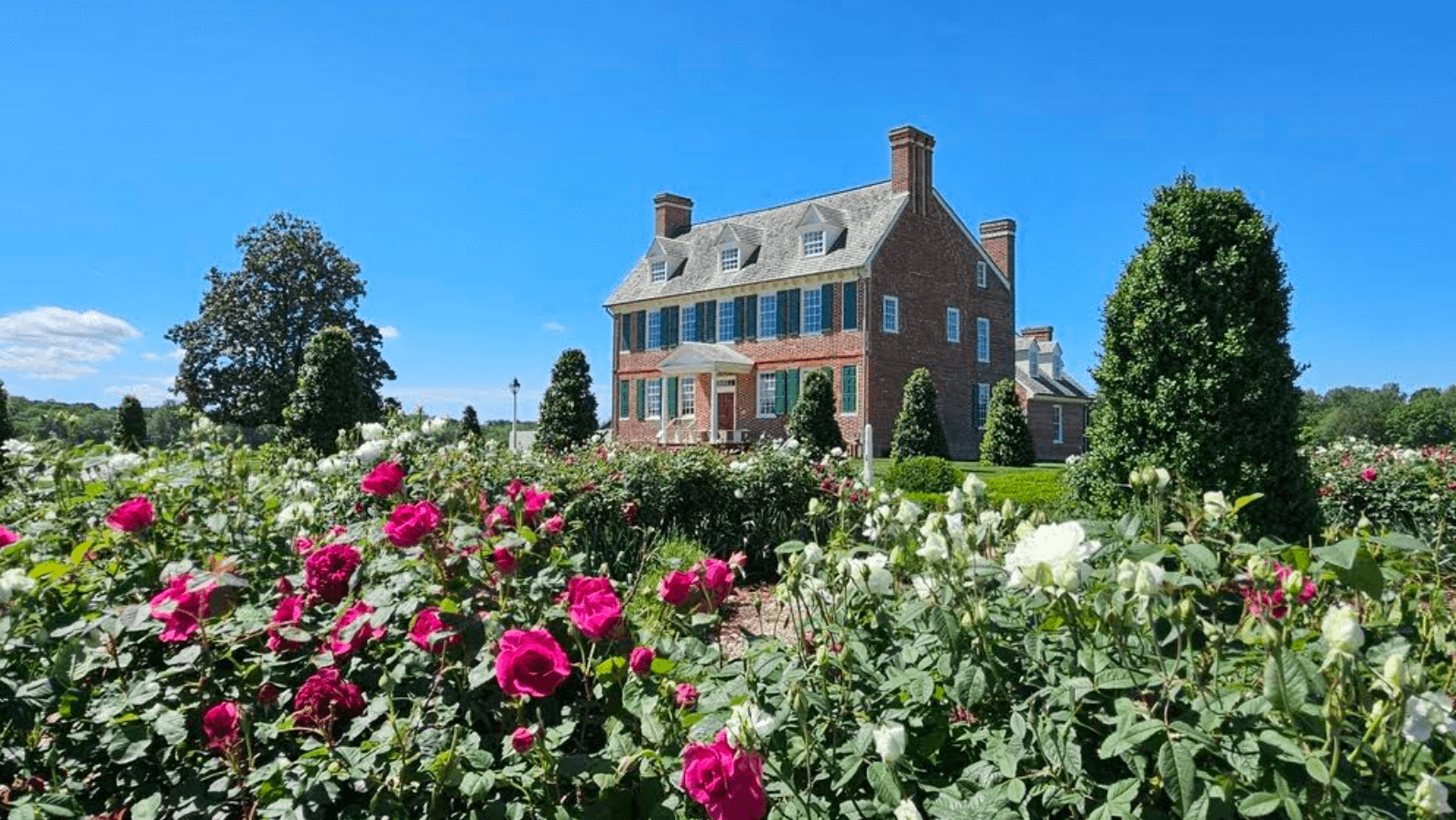
In addition to acting as procurement officer, Colonel Hemsley served as Queen Anne’s County Justice of the Peace in 1777 and served in the Maryland State Senate 1779 – 1781, returning to the Senate in 1786, 1790, and 1800. He represented Maryland in the Continental Congress in 1782 and 1783. With his wife, Sarah, he managed a renovation and expansion of Cloverfields, completed in 1784. Colonel Hemsley died in Queen Anne’s County on June 5, 1812, just before the start of the War of 1812. Cloverfields was sold out of the family in 1897. In 2018, it was purchased by the Cloverfields Preservation Foundation, established in 2004 and headed by a descendant of Colonel William Hemsley.
Between 2018 and 2021, as part of the Foundation’s primary mission, the house and gardens were restored to their primary period of historical significance—1784. The Foundation now supports efforts to uncover and tell the story of the house, the gardens, and the people who inhabited them through the centuries. While the property is not currently open to the public for tours, it does serve as a resource for skilled historic tradesmen and women, architects, and others to investigate 18th-century construction, ornamental and decorative woodwork, plaster repair and restoration, paint types and colors, and colonial gardens.
As we honor the patriots who led and supported Revolutionary War efforts—including those who provided goods to the Army—we cannot forget the tens of thousands of enslaved people on the Eastern Shore of Maryland who labored in the fields and mills to produce the crops and resulting products that fed the troops, whose unpaid and unspoken efforts were essential to victory and the forming of the nation.
Sherri Marsh Jones, Director of Research and Special Projects at the Cloverfields Preservation Foundation, writes, “. . . as with most colonial mansions, Cloverfields comes with a complicated past that includes a legacy of slavery. Enslaved craftsmen were essential in the building of Cloverfields and, afterwards, carrying out the onerous day-to-day work associated with plantation operations. Cloverfields’ historians continue to research the enslaved individuals and families who lived and labored at Cloverfields, and the Cloverfields Preservation Foundation is committed to recognizing their contribution and honoring their legacy.”
In 2025, the Foundation took over ownership and stewardship of Old Wye Mill through a partnership with the Friends of Wye Mill to preserve, maintain, and interpret the mill’s history, technology, and cultural significance. Old Wye Mill invites people of all ages, individuals as well as families and groups, to learn more about the mill and its significant history.
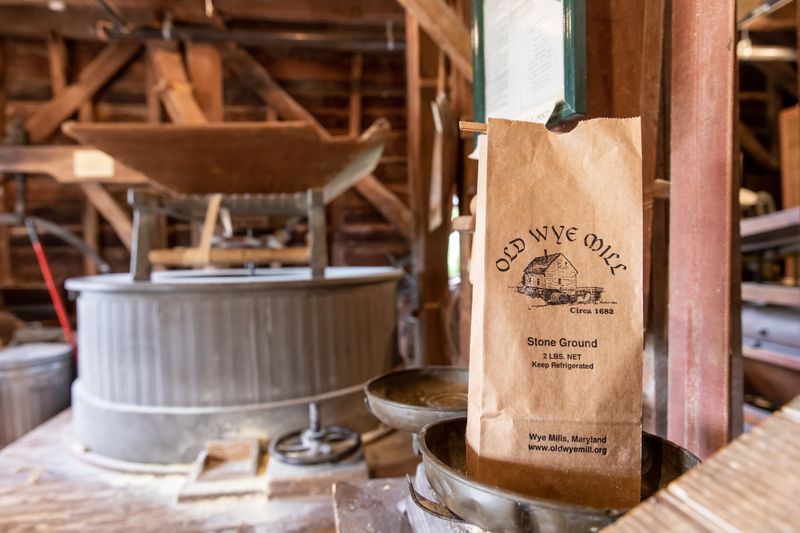
The Mill is open May – October each year Wednesday – Saturday 10 am – 3 pm and Sunday 1 – 3. Grinding days take place the first and third Saturdays of these months. Old Wye Mill also sells products.
This year, the Opening Day Celebration is scheduled for May 2, 2026 with flour grinding demonstrations, colonial cooking, reenactors, a bake sale, and more.
For more information, visit https://oldwyemill.org or call 410-827-3850
900 Wye Mills Road, Wye Mills, MD
——————————————————
Thank you to Sherri Marsh Jones, Director of Research and Special Projects at the Cloverfields Preservation Foundation, and John Nizer, former President of the Friends of Old Wye Mill, for sharing their time and expertise.
Additional sources:
Mildred C. Schoch, The Endeavours & Exertions of Queen Anne’s County, Maryland During the Revolutionary War 1775 – 1783 (Annapolis: Maryland State Archives, 1975).
https://www.americanrevolution.org/middle-colonies-economy/
https://apps.mht.maryland.gov/medusa/PDF/QueenAnnes/QA-462.pdf
https://whatsupmag.com/culture/the-history-within-cloverfields/
Back to Blog